
 MENU
MENULighter Flywheels vs Performance Gains.
"Getting into a spin with Flywheels"
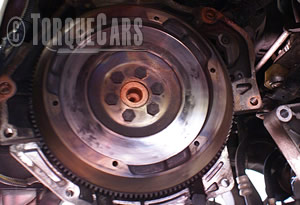
In this article we are going to look at performance flywheels. We'll discuss what a flywheel does, what the advantages and disadvantages of lighter flywheels. We will also look at conversions from a dual mass flywheel to a single mass unit.
Who benefits most from a light weight flywheel? Let's kick off this discuss with an overview of flywheels.
What does a Flywheel do?
What is a flywheel? It basically stores kinetic energy from the engine much like the wheel in the toy cars you used to rev and release and let it zoom off.
This heavy wheel cited between the engine and the gearbox builds up rotational force with speed and momentum smoothing out an engine.
A flywheel effectively helps a car resist changes in engine speed - which is good for cruising at a steady speed but bad when you need a fast engine speed change response.
A reciprocating piston engine is naturally prone to vibration, and the flywheel aids in keeping everything spinning. Additionally, it resists engine speed drops that occur as you approach a slope or ease off the throttle, which makes driving the automobile much simpler.
What happens if you were to remove your flywheel?
Without a flywheel, it is doubtful that your automobile would tickover and would simply stall; also, you would lose speed on every hill and incline encountered.
Upgrading your flywheel to a lighter performance version
So, let us examine the advantages and disadvantages of flywheels, as well as the upgrade choices available and their associated downsides and benefits.
If your flywheel is very heavy and the vehicle retains its revs for an extended period of time, for example, making gear changes much slower while you wait for the revs to meet the gearbox RPM, a lighter flywheel is the way to go.
They are not recommended if you have an aggressive cam profile installed, since the engine will be more lumpy and will stall more readily with a lighter flywheel.
Dual mass flywheels are used. These consist of two surfaces that are linked by a spring.
The spring dampens the rotational changes in acceleration and deceleration; it softens the engine pulses. This is especially useful in V5 engines that are somewhat out of balance, as well as in the majority of turbo diesel engines.
Downsides of a heavy flywheel
This is not all good news. It takes effort to get the wheel rotating and stops quick changes of engine revs.
A lighter wheel takes strain off the engine and allows the engine to rev more freely, as a bonus as there is less weight the engine is able to release more power when speed increases. But power also tails of more quickly.
See our video on this topic for a discussion on flywheels and how to improve them.
You’ll notice the revs on a race-tuned engine with light flywheel increases and drops a lot more quickly than a standard engine.
The big downside to a lighter flywheel is that engine momentum or inertial spin is reduced – most noticeably on a hill.
Benefits and Drawbacks of lighter flywheels
The momentum in an engine is maintained with a heavy flywheel but when this is lightened the momentum stored is reduced and the hill has a much more immediate impact on the engine output.
Lighter flywheel benefits
Lighter flywheels come into their own in a race situation where the track is flat and there is a demand for fast engine speed changes and the engine has been tuned with high revving characteristics in mind.
Heel and toe gear changes and engine braking take advantage of the greater responsiveness from the engine with a lighter flywheel.
Lighter flywheel drawbacks
Speed will drop more quickly on hills and inclines and the car is more likely to stall, particularly if the car has a lumpy idle. This is the case in many V5, many diesel engines and modern engines with cylinder on demand designs.
Choosing a flywheel for your project car
There are many different options and weights of flywheel so you should be able to get the best compromise for your car and driving characteristics.
Different grades of flywheel are available for different applications. For street cars you don't want to go too light or your tick over may suffer and the car will be hard to drive in heavy traffic.
Generally speaking a road car will benefit with a 1-2kg drop in the weight of the flywheel and should not experience detrimental effects, this obviously varies according to your engine so we urge you to reach out and do your research carefully.
When to change your flywheel?
If you're changing a clutch, you may as well sort out the flywheel while you're at it, since most automobiles need the flywheel to be removed in order to access the clutch housing and assembly.
If your flywheel is very heavy and the vehicle retains its revs for an extended period of time, for example, making gear changes much slower while you wait for the revs to meet the gearbox RPM, a lighter flywheel is the way to go.
Can you lighten your existing flywheel?
If you feel tempted to make your own light weight flywheel by drilling holes in it. DON'T! TorqueCars remind you that the slightest imbalance can cause major issues.
Even standard flywheels that are put into cars are balanced. Any wobble or vibration in the flywheel can have disastrous consequences on the engine.
Effectively this will reduce your red line and restrict your power band. A broken flywheel can cause a lot of damage. It effectively sends a buzz saw of metal through the car potentially causing injury to driver or passenger depending on engine orientation and location.
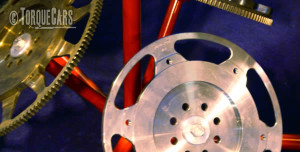
Off the shelf lightened flywheels are carefully balanced and come with holes and gaps like an alloy wheel.
They can be made of various alloys blended for strength and lightness.
If you are replacing a clutch you may just as well get the flywheel sorted while you are at it and at least see if there is a performance choice open to you.
What about DMF to SMF conversions?
Dual Mass flywheels have two separate surfaces which are connected via a spring.
Dual mass flywheels are used in many engines, from diesels to large v8 petrol units. These consist of two surfaces that are linked by a spring.
The spring dampens the rotational changes in acceleration and deceleration; it softens the engine pulses.
This is especially useful in V5 engines that are somewhat out of balance, as well as in the majority of turbo diesel engines.
A DMF can be a pain when they start to go wrong, and some of our members are replacing them with solid and lighter flywheels but we suggest your read our guide on DMF to SMF conversions first.
If you are serious about lightening bits and pieces to get a free revving engine try a carbon fibre drive shaft.
These have the advantage that they rotationally flex more than their metal counterparts which will reduce strain on the engine absorbing some of the shock from engine speed changes.
A carbon fibre driveshaft is stronger than a metal one, if designed properly, but if it does break it will 'broom' into 'harmless' fibres and little damage will be done to the car.
Why not chat with our members in the TorqueCars car forums to discuss your required application.
For more tips and advice on car tuning and modification we suggest you join our very friendly modified car forum and get some specific tips and advice for your car and swap ideas with our enthusiasts.
Please Check out my YouTube channel, we're regularly adding new content...
 Click to accept YouTube Cookies & Play.
Please share this page with your friends on :


PLEASE HELP: I NEED YOUR DONATIONS TO COVER THE COSTS OF RUNNING THIS SITE AND KEEP IT RUNNING. I do not charge you to access this website and it saves most TorqueCars readers $100's each year - but we are NON PROFIT and not even covering our costs. To keep us running PLEASE Donate here
If you liked this page please share it with your friends, drop a link to it in your favourite forum or use the bookmarking options to save it to your social media profile.
Feedback - What do You Think?
Please use our forums if you wish to ask a tuning question, and please note we do not sell parts or services, we are just an online magazine.
Help us improve, leave a suggestion or tip
Please watch this video and subscribe to my YouTube channel.